Surgery 1/4

I remember Columbus Day 2016 like it was yesterday. What a weird statement to make. Who remembers Columbus Day?

Besides having no school that day, it was also the first time I was seeing my doctor in about 3 months. I was beyond nervous. How was I going to convince him that I needed surgery when my MRI was inconclusive and my only symptom was this unreachable pain, but at 16 I knew how to advocate for myself. Hesitantly, he scheduled me for a scope and debridement less than a month later.

While I was excited to finally have answers, I prayed that my volleyball season would be over by the November 4th surgery date. I was nearly in tears any time I jumped and landed. I couldn’t take the 3 jogs we made across the court because I was just too afraid to start the stabbing sharp pain. My vertical was limited and my speed had decreased. But I still loved my team and the sport. I just wanted to give it everything I could.

Lucky for me, our season ended just two days before my first surgery. But damn, I wish someone would’ve told me it would be the last game I would ever play.

The morning of surgery, I not only couldn’t recognize any of the wording on the pre-op paperwork, I didn’t recognize my doctor. I promised myself that if this surgery didn’t solve the problem, I needed to be more familiar with my injury, and oh was I in for a surprise.

Waking up post surgery, I kept reaching at my knee in recovery, trying to feel what they had put on it in hopes that I could determine what was wrong. While I couldn’t feel anything besides the stiff ice wrap, I didn’t have to wait long to find out what was actually wrong.

It was the worst case scenario. An injury my doctor had mentioned, but had not anticipated to this scale. My knee was cleaned out, but with little hope that my pain would improve, and a small biopsy of healthy tissue was taken in order to prep for the possibility of a more extreme and experimental surgery. I was officially diagnosed with what I most feared: a grade 4 articular cartilage defect of the patella. The most difficult to treat, and one of the most painful defect locations.
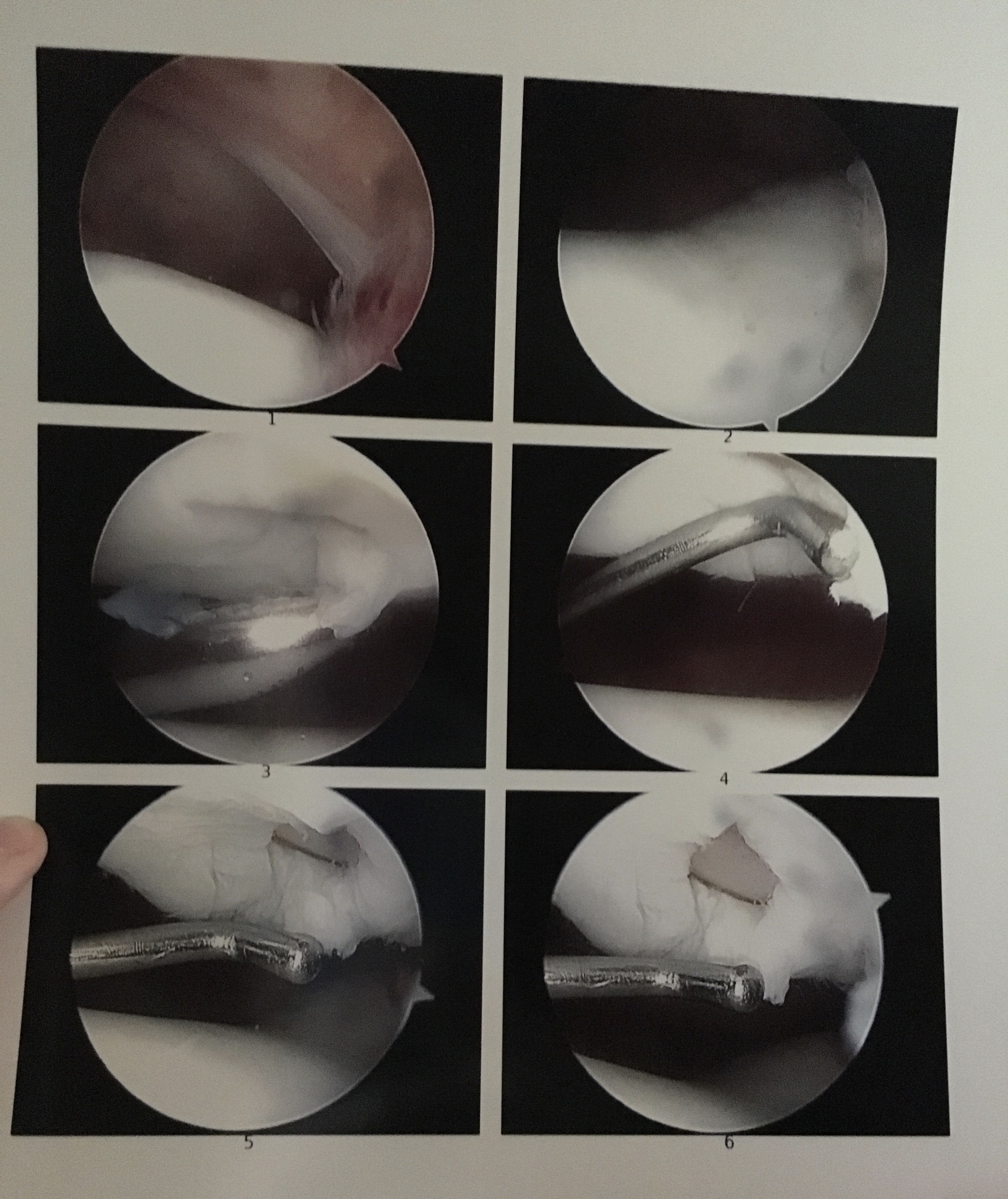
I had to prepare myself for an injury I could barely understand, and I could tell from the tone in my doctor’s voice, that mine and his relationship was going to be a long-term one.

Thinning and Speckled Cartilage

After waiting nearly 3 hours and missing the end of the school day, when I anticipated missing one class at most, this was the extent of the explanation I received.

I was told at this stage, from what could be determined by my MRI, surgery was unnecessary and treatment beyond physical therapy and the synvisc-one injection I had received was overkill.

I still lacked clarification. Although more invasive treatment options were out of the question, they were all presented, and I was EXTREMELY confused. I understood what a scope and debridement was, but what was ACI, and why was there not a single understandable source on what the surgery entailed?

Hearing that I had “thinning and speckled cartilage” finally caused things to click in my head. This wasn’t an everyday knee injury for someone my age, and it wasn’t the torn meniscus I was originally told I might have. This wasn’t and isn’t an injury that can be repaired in a straightforward manner, and there continues to be a possibility in the present-day that my only permanent repair is full knee replacement.

Over the next 3 months, I would continue the regime of physical therapy originally prescribed, constantly searching for a physical therapist that would focus on my whole body in hopes that would solve the problem going on within my knee. This was little help no matter how invested or qualified the physical therapist. I was in so much pain, I couldn’t bend my knee standing or lay it flat in bed.

I was confused how cartilage could control by body and my life in this way, and I begged for more invasive treatment.

Summer “Workouts”

“One of our top Juniors is out for now with a knee injury, but we’re not concerned.”

It was a blip in a local article. Just a blip. But for some reason I couldn’t help but feel that everyone knew something I didn’t. Why mention it? Why let every coach in the conference know that I was injured when I would be playing 6 rotations for the first time in my life? But God, forget about it, it’s just a blip.

Soon the article wouldn’t matter, because the giant J-shaped brace to push over my patella to help relieve pain and my inability to run or move laterally gave myself away before I could even get out of the summer “workout” season.

Maybe it was these “workouts” that killed me. Grueling 2-4 hour practices in a non-air conditioned gym that would help “condition” us for the upcoming season. In reality these practices resulted in the greatest number of injuries, and helped to worsen the mangled mess of cartilage that laid hidden within my knee joint.

I spent that summer bouncing between practice and physical therapy with a cortisone and Synvisc-one shot mixed in–all without a diagnosis. My MRI was inconclusive; physical therapy and shots were providing no relief, and I was waking up each morning in more and more pain.

At this point, it wasn’t about the recruiting. It wasn’t about being ready for the fall season, or even getting through a single summer “workout.” I was in the worst pain in my life, unable to straighten my leg in bed or walk up or down the stairs.

I wanted out. I wanted answers. I wanted help.